In 2026, a programmer shared his development journey on social media: he completed a project simulating Claude CLI interaction, dubbed “Mini-Claude,” in under 7 hours across three evenings after work. In traditional development, building such a tool from scratch would typically take weeks.
This leap in efficiency is not due to a sudden enhancement in his personal abilities, but rather the adoption of a new approach called Vibe Coding.
Vibe Coding, proposed by OpenAI co-founder Andrej Karpathy in 2025, promises that “if you can talk, you can code.” While it may sound like a marketing slogan, it is backed by a comprehensive, executable technical and collaborative system. It does not merely turn AI into a “typist” but fundamentally restructures the software development process of human-machine collaboration.
The First Pillar: A Real-Time Interpreter for Turning Speech into Code
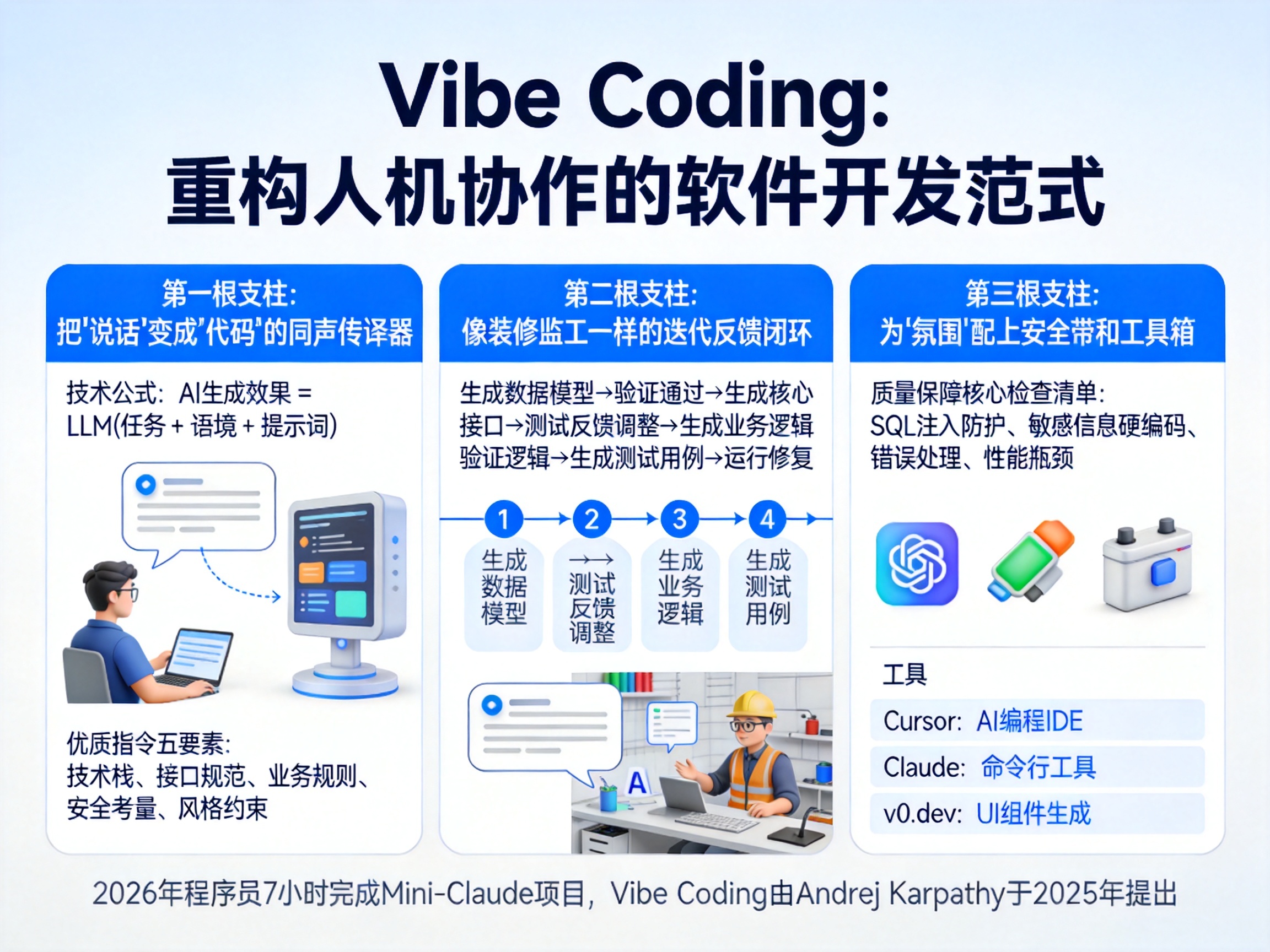
The first step in achieving “if you can talk, you can code” is addressing the language translation issue. The core of this is a technical formula: AI Output = LLM(Task + Context + Prompts).
You can think of this process as a top-notch simultaneous interpreter. You (the developer) describe your requirements (task) in natural language (like English or Chinese), and the interpreter (large language model) needs to accurately translate it into another language (programming code). A good translation requires not only understanding the literal meaning but also grasping the context (environment), such as the project’s technical style and existing architectural conventions.
Additionally, you need to provide clear instructions (prompts) on which dialect to use (Python or JavaScript) and what etiquette to follow (coding standards).
A poor instruction might be: “Write a login feature.” This is akin to telling a translator: “Help me say hello."—the result could be wildly off. In contrast, high-quality instructions advocated by Vibe Coding include five key elements:
- Tech Stack: “Implement using FastAPI 0.100.0 and SQLAlchemy 2.0”
- Interface Specification: “POST /api/auth/login, request body includes email and password fields”
- Business Rules: “Return 401 error on login failure; lock for 10 minutes after 5 failures from the same IP within 5 minutes”
- Security Considerations: “Use bcrypt for password hashing and comparison”
- Style Constraints: “Follow the existing JSON response format of the project”
When instructions are clear enough, LLMs (like Claude, GPT-4o) trained on vast amounts of code can map your business intent directly into structured, executable code like a skilled translator.
The Second Pillar: Iterative Feedback Loop Like a Renovation Supervisor
Code generation is just the beginning. The essence of Vibe Coding lies in establishing a “Describe-Generate-Feedback-Optimize” human-machine collaboration loop. This is no longer a one-way command but a continuous dialogue.
This process resembles hiring a versatile renovation team while acting as the supervisor. You don’t need to lay bricks or paint (write code) yourself, but you must clearly communicate to the foreman (AI) what you want: “The living room should have a bright modern style, and I want a set of storage cabinets here.” The foreman will first create a part (like building the walls) for you to review (run validation). If you think the cabinet position is wrong, you can say: “Move the cabinet 20 centimeters to the left.”
The foreman will adjust immediately. This “small steps, quick iterations” approach is far more efficient and controllable than providing all the blueprints at once and discovering issues after everything is completed.
In Vibe Coding, this is reflected in phased development:
- First, let the AI generate the data model (about 50 lines of code) → validation pass
- Then generate the core interface (about 80 lines of code) → testing reveals issues → feedback for AI adjustments
- Next, generate the business logic (about 120 lines of code) → validate logic
- Finally, generate test cases (about 60 lines of code) → run and fix
Each piece of feedback, such as “This query interface is too slow and has an N+1 problem; help me optimize it into a join query,” can be understood and corrected by the AI. Developers transition from being “bricklayers” of code to focusing on the overall effect and architecture as “supervisors” and “designers.”
The Third Pillar: Equipping the Atmosphere with Safety Belts and Toolboxes
If only the first two points were present, the generated code might run but be fragile, resembling a “Demo code.” To apply Vibe Coding in practice, the third pillar is essential: comprehensive quality assurance and tool ecosystem. This is akin to equipping an efficient renovation team with project supervision, quality inspection tools, and a good set of equipment.
Quality assurance is the safety belt. The industry widely emphasizes that AI-generated code must never go live without review. Manual code reviews are essential, focusing on a core checklist that includes:
- SQL injection protection (whether parameterized queries are used)
- Whether sensitive information is accidentally hard-coded
- Completeness of error handling and boundary conditions
- Identification of performance bottlenecks (like N+1 queries)
Additionally, automated testing defenses must be established, including unit tests, API tests, and end-to-end tests, to ensure that each iteration does not break existing functionality.
The tool ecosystem is the accelerator. A specialized tool matrix has already formed around Vibe Coding:
- Cursor: Considered the strongest AI programming IDE, deeply integrated with large models, allowing quick inline generation or modification of code with Ctrl+K and interaction with the entire codebase using Ctrl+L.
- Claude Code: A command-line tool suitable for large-scale, project-level code modifications and refactoring.
- v0.dev: Focused on UI components, generating React+Tailwind code directly from descriptions.
These tools, through project-level configuration files (like .cursorrules), enable the AI to continuously remember the project’s tech stack, coding standards, and architectural requirements, ensuring the generated code aligns with the overall “atmosphere” of the project.
Thus, Vibe Coding’s realization of “if you can talk, you can code” does not rely on a single magic trick. It results from the combination of precise intent translation, efficient iterative dialogue processes, rigorous quality review, and powerful specialized tools.
It compresses weeks of traditional development workload into hours, fundamentally evolving the role of developers: from “micro-managers” writing line-by-line instructions to “commanders” defining goals, reviewing results, and steering direction. This is not just an efficiency boost; it represents a profound transformation in the software development paradigm.
Comments
Discussion is powered by Giscus (GitHub Discussions). Add
repo,repoID,category, andcategoryIDunder[params.comments.giscus]inhugo.tomlusing the values from the Giscus setup tool.