
Anthropic has made a surprising move!
To use Claude, users must first complete identity verification.
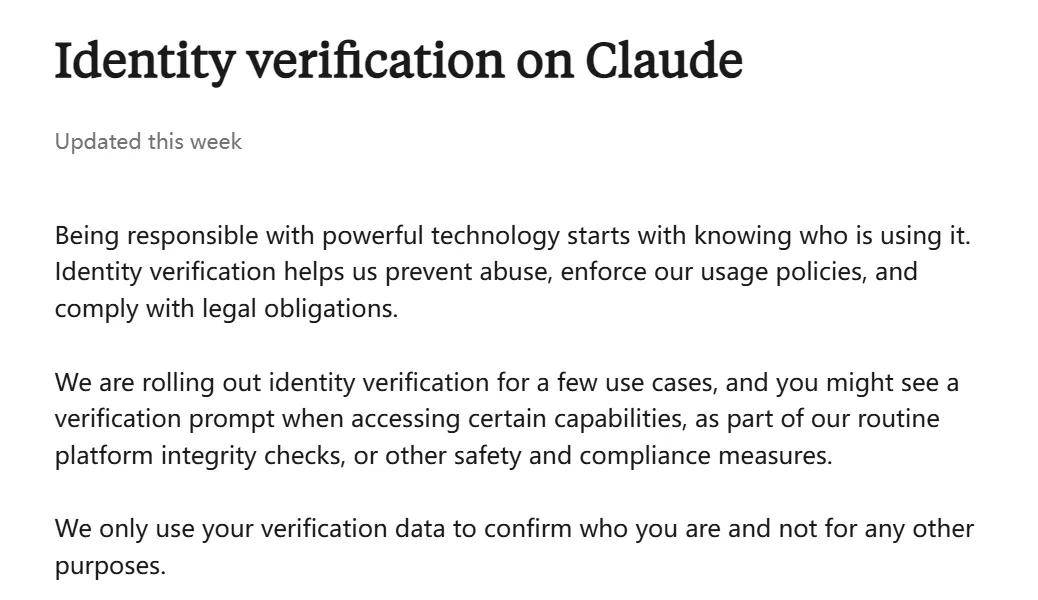
Verification process details:
You need to prepare the following materials:
- A valid government-issued photo ID (must be a physical document and in your possession)
- A smartphone or computer with a camera: you may need to take a live selfie with your phone or use your computer’s webcam
- A few minutes: verification usually completes within 5 minutes
Acceptable ID types include: passport, driver’s license, or state/provincial ID, and national ID. The document must be government-issued, clearly readable, undamaged, and contain your photo.
Note that the following documents are not accepted: photocopies, screenshots, scans, electronic or digital IDs (like mobile driver’s licenses), non-government IDs (like student IDs, employee IDs, library cards, bank cards), and temporary paper documents.
This unexpected move by Anthropic has drawn criticism online: many users feel it is too harsh.
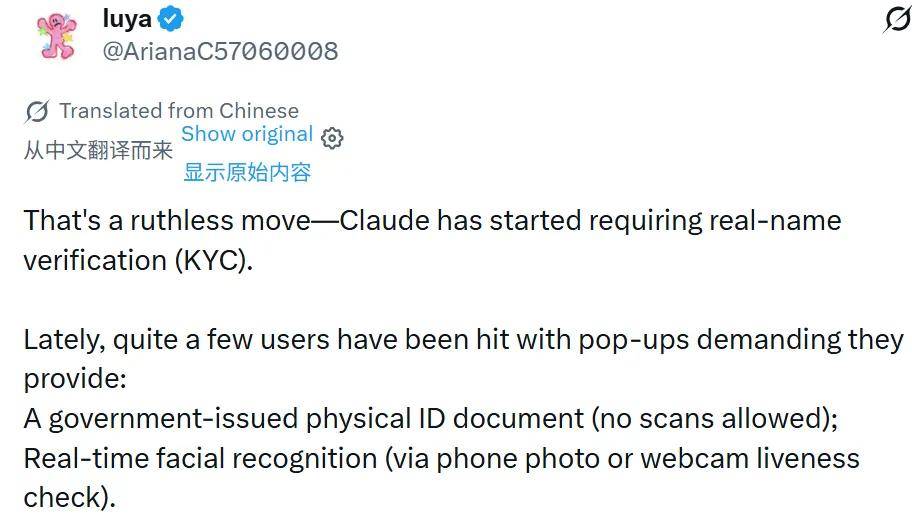
“This is outrageous! Anthropic’s action is clearly aimed at eliminating intermediaries and bulk accounts. This is no longer a small-scale trial, but a gradual rollout — high-frequency users and Claude Max users will likely be subjected to this stringent verification.”
Some users are even asking online how to bypass the Persona Identities verification.

On one side, Anthropic raises the barriers for access, requiring paying users to provide “real person + ID + face scan”. On the other side, a group of overseas developers is trying various methods to access Chinese platforms, creating a surreal situation.
Domestic Coding Plan is appealing, let’s create!
Claude users are focused on how to pass the identity verification hurdle. However, another wave of users (specifically foreign developers) is trying to figure out how to register for WeChat, bind Alipay, and pass Chinese graphical verification codes.

This situation is quite absurd.
The peculiar experiences of these overseas users began with the release of GLM-5.1. After a noticeable improvement in model capabilities, the GLM Coding Plan quickly gained popularity overseas, igniting demand.
However, with the increase in intelligence levels and global computing power constraints, the overseas pricing for the GLM Coding Plan was adjusted upwards. The overseas Max package monthly fee increased from $80 to $160, Pro from $30 to $72, and Lite from $10 to $18 (all including a 10% invitation discount).
In contrast, the same Max package is priced at 469 yuan (approximately $68) domestically, meaning the increased overseas version price has surpassed double that of the domestic version.
Adding to this, the 10% API price adjustment coincided with the GLM-5.1 release. Who benefited from this? Let’s not say.
But since it’s useful, some began to think creatively. Foreigners discovered that the Chinese version of the Coding Plan is cheaper, so they started exploring ways to save money by purchasing the cheaper GLM Coding Plan from the Chinese site.
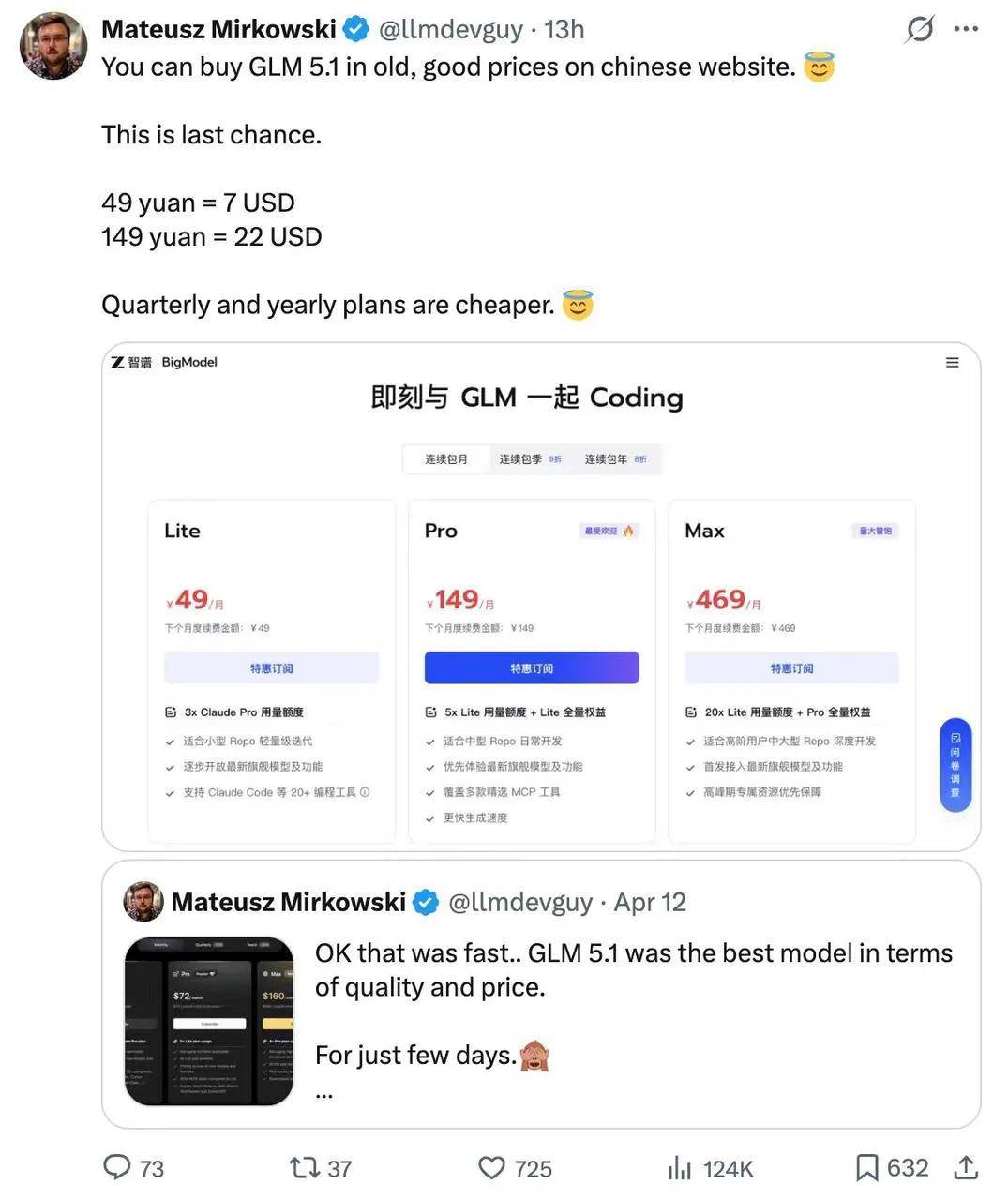
Thus, a surreal scene appeared on X: foreign developers with English IDs began seriously researching how to buy the Chinese version of the GLM Coding Plan: do they need an ID, how to bind Alipay, can they use overseas credit cards?

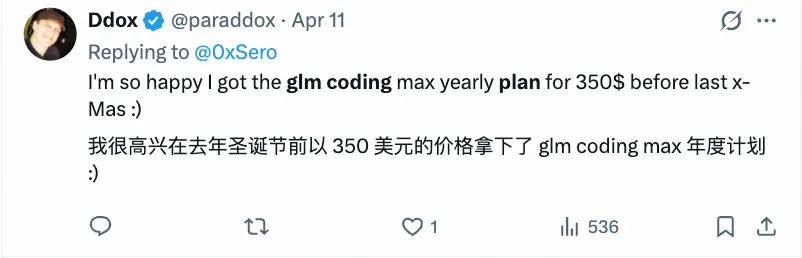
Those who couldn’t grab it were struggling, while those who had already purchased were enjoying the benefits. User @Ddox boasted a bit: “I’m glad I bought the GLM Max annual membership last year.”
While overseas friends are researching strategies, the excitement domestically is equally intense.
The GLM Coding Plan is released daily at 10 AM, and it’s so popular that users rush to it; if you’re a second late, it’s gone. Domestic user @0xkakarot888 lamented, “How did you manage to grab the GLM Coding Plan? Buying a model requires a flash sale? I’ve never seen this before; at 10 AM, the page was too crowded to access, and at 10:01 AM, it opened but was sold out…”
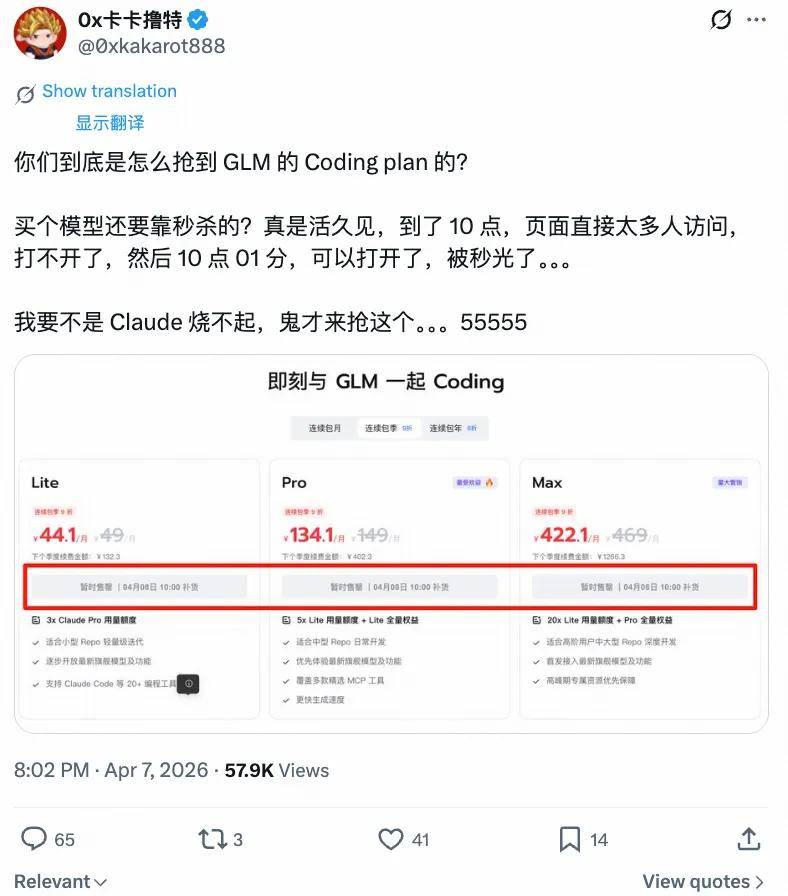
Now, on platforms like Xianyu, “buying GLM Coding Plan on behalf of others” has become a business. Who would have thought that besides concert tickets, even programming packages have scalpers?

Of course, overseas users have also noticed this issue and started setting alarms to grab it at 10 AM Beijing time.

On X, a “purchasing service for foreigners” has emerged. @iamai_eth tweeted: “I can help foreigners buy GLM and earn the price difference.”
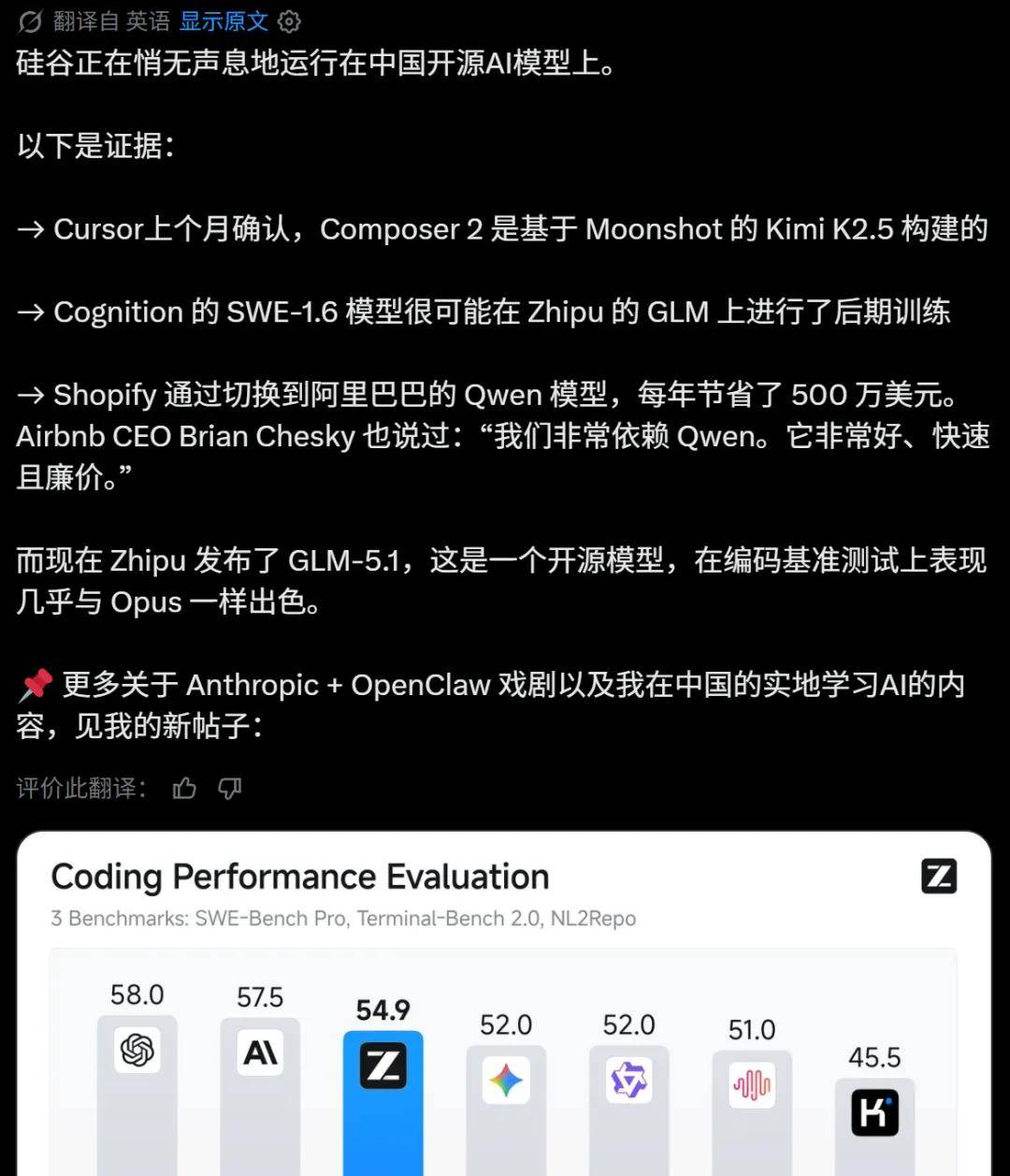
Why are foreigners willing to navigate Chinese payments and various pitfalls to buy the Chinese version of the GLM Coding Plan?
The answer lies in product reputation.
Victor Mustar, product lead at Hugging Face, stated that he built a Three.js racing game with 531 lines of code using GLM-5.1, featuring realistic drifting physics and four AI character personalities, all without visual aids; the model iterated and completed over 20 debugging sessions on its own.
He believes this performance even surpasses the combination of Claude Code and Opus 4.6, predicting that this model will spark widespread discussion.
In reality, the current AI landscape in Silicon Valley is undergoing a “reshuffle”. As top AI companies in the U.S. (like OpenAI and Anthropic) move towards closed ecosystems and high premiums, Chinese companies are quietly capturing developers’ desktops through cost-effectiveness and open-source solutions.
Many developers have found that when rapid implementation of specific functions is needed, some domestic models not only respond quickly but also generate concise and straightforward code. For Silicon Valley startups needing large-scale deployment, the money saved translates directly into profit.
On one side, Claude users are facing cameras for facial recognition, proving their identity; on the other side, overseas developers are studying Chinese verification codes, striving to prove they can purchase. This situation is quite surreal.
Comments
Discussion is powered by Giscus (GitHub Discussions). Add
repo,repoID,category, andcategoryIDunder[params.comments.giscus]inhugo.tomlusing the values from the Giscus setup tool.